Starting Jan. 1, many Missouri adults who got health coverage through the state’s Medicaid expansion will have to show they work, go to school, or volunteer to keep it.
The new rules apply to adults ages 19 through 64 in MO HealthNet’s Adult Expansion Group, according to the Missouri Department of Social Services. The state counted 338,093 people in that group as of Oct. 23, according to the department’s caseload counter.
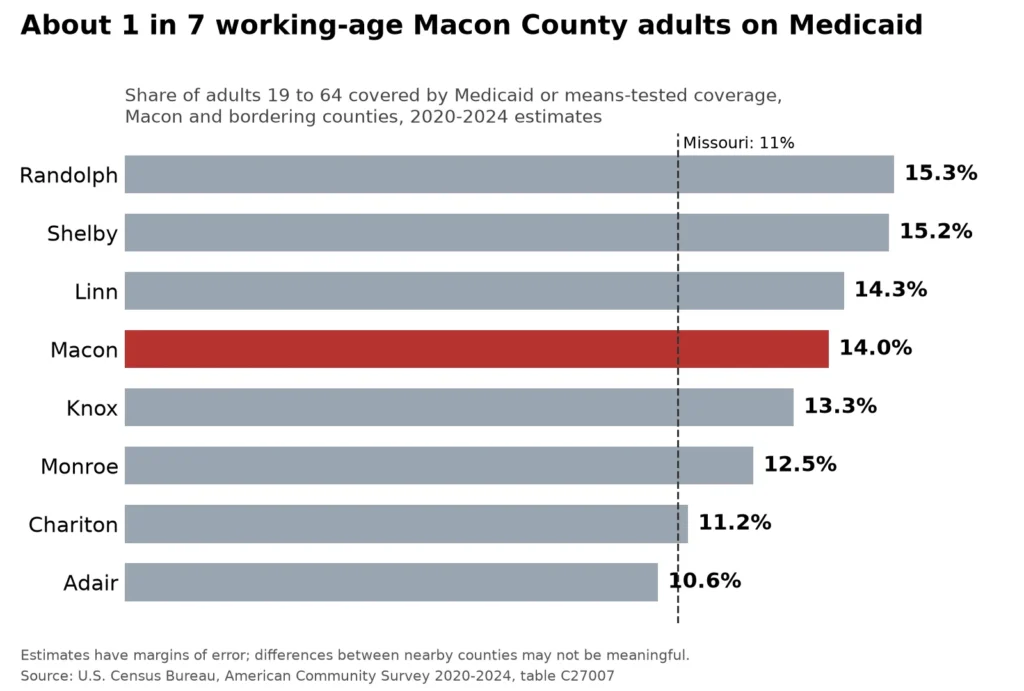
Macon County does not have a separate count of expansion enrollees in the published data. Census estimates give a sense of the reach, though. About 1,115 Macon County residents ages 19 to 64, or 14 percent of that age group, had Medicaid or other means-tested public coverage, according to the U.S. Census Bureau’s American Community Survey for 2020 through 2024. Statewide, the share was 11 percent.
The Census figure covers every working-age adult on Medicaid, not only the expansion group, so it likely overstates how many local people the new rules will reach. It also carries a margin of error of about 205 people.
Among the seven counties that border Macon, Randolph and Shelby counties had the highest shares at about 15 percent. Linn County had 14 percent, Knox County 13 percent, Monroe County 12.5 percent, Chariton County 11 percent, and Adair County 10.6 percent.
The requirements come from the federal law known as H.R. 1, signed July 4, 2025, which requires states to add them as a condition of coverage, DSS said.
To meet the rules for a month, a person can work at least 80 hours, whether at a job, through self-employment, or through gig or cash work. Volunteer work counts if it is part of a structured program run by a public agency or nonprofit. Going to school at least half time also counts, and people can combine work, volunteering, and training to reach 80 hours. Income can stand in for hours. In 2026, that amount is $580 for the month, which is the federal minimum wage times 80, the department said.
Missouri will check one month, not every month, DSS said. People already covered must meet the rules in at least one month since their last renewal. Starting in 2027, expansion-group members will renew every six months instead of once a year.
Several groups do not have to meet the rules once the Family Support Division confirms they qualify. They include pregnant women and new mothers on postpartum coverage, people with Medicare, parents or caretakers of a child 13 or younger, people who care for someone with a disability, people found medically frail, people in drug or alcohol treatment, and veterans rated 100 percent disabled. Children and adults 65 and older are not covered by the rules.
Missouri chose not to use an optional short-term hardship exception, so losing a job, a short illness, or a family emergency will not automatically excuse someone, according to the department’s guidance.
If the state cannot confirm that a person met the rules, it will send a notice giving 35 days to respond. Coverage stays in place during that time for people already enrolled. Anyone whose coverage ends can apply again and can ask for a fair hearing.
DSS began mailing informational notices about the change in August. The department says those notices do not end anyone’s coverage and do not need a reply. It advises enrollees to keep their address current with the Family Support Division, read every letter, and keep records of work, school, and volunteer hours, but not to send proof until asked. A screening tool on the DSS website helps people see whether the rules apply to them.
In Macon County, documents can be dropped off at the Family Support Division’s Macon Resource Center, 1716-B Prospect Drive, as Chariton Media Group reported Oct. 2 in its story on new SNAP paperwork rules.