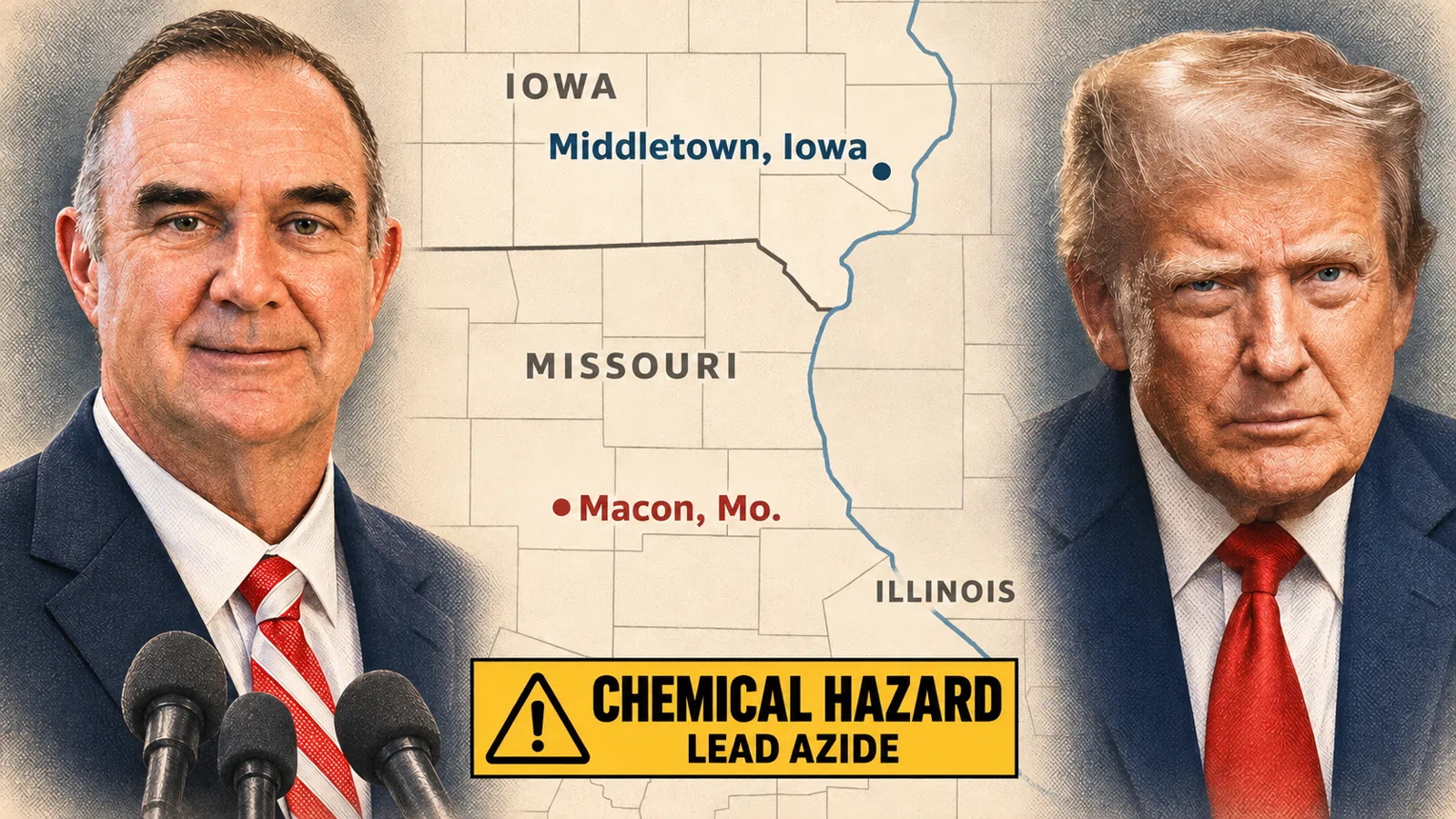
Gov. Mike Kehoe said Monday that Missouri expects little effect from the Army's planned detonation of lead azide at the Iowa Army Ammunition Plant, but the state is setting up extra air, water, and livestock monitoring in case northeast Missouri is affected.
"Based on the information we do have, we anticipate minimal impacts to Missouri," Kehoe said at a news conference with four state agency directors. "We believe there are no significant health risks to Missourians and livestock, and we are prepared to monitor in the wake of this detonation to ensure this is the case."
He told residents, "I want Missourians to know that this is not a time for panic."
Kehoe said he activated a multi-agency state team Friday and the state will open the State Emergency Operations Center once the federal government gives definitive word on when the detonation will happen.
"But I want to emphasize this is a federal operation," he said. "The states of Iowa, Missouri, and Illinois do not have a say in when this is conducted." He said he joins other governors and officials in their frustration with how it has been handled.
Jake Buxton, director of the Missouri Department of Natural Resources, said the department does "not anticipate sustained concentrations of lead that amount to levels that threaten human health and the environment in Missouri." He said Missouri has 10 drinking water systems and 13 intakes within 100 miles of the site, and the EPA is sampling surface water systems in that radius before and after the event.
"All surface water systems have treatment processes in place," Buxton said. He said the department contacted the Hannibal and Louisiana water systems, which draw from the Mississippi River, and both can filter lead.
Sarah Willson, director of the Missouri Department of Health and Senior Services, said, "To be clear, the Department of Health and Senior Services has not communicated that we anticipate this being a public health emergency for Missourians." She said people with concerns about lead dust should contact their local public health agency or health care provider.
Chris Chinn, director of the Missouri Department of Agriculture, said her family farm is in northeast Missouri and that advice to bring livestock inside does not come from her department. She urged producers with concerns to work with their veterinarian and said University of Missouri Extension can test hay for lead.
"If a layer of dust appears on your equipment following the detonation and you are concerned, wash and wipe down your equipment," Chinn said.
Mark James, director of the Missouri Department of Public Safety, said a National Guard civil support team that specializes in plume modeling is providing data, and the State Emergency Management Agency has lined up supplies and a distribution plan. He said information will be posted on a landing page on the Department of Natural Resources website.
"I would just, admonish folks to please get your information only from trusted sources," James said.
Asked about areas farther south, Kehoe said, "I would not see central Missouri, Columbia, southwest Missouri, I would not see any model that would affect any of those areas of the state." He said a case is before the 8th U.S. Circuit Court of Appeals.
The Army said Sunday that the detonation at the plant in Middletown, Iowa, is scheduled for Wednesday. Macon is about 100 miles southwest of the plant.